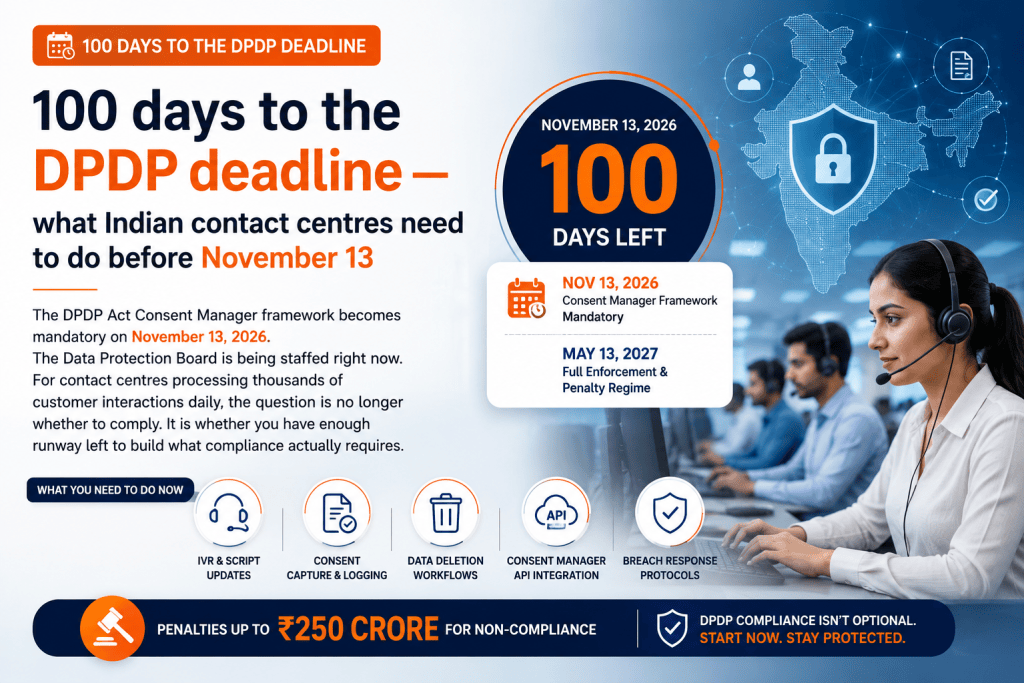
The DPDP Act Consent Manager framework becomes mandatory on November 13, 2026 — 98 days from today. The Data Protection Board is being staffed right now. For contact centres processing thousands of customer interactions daily, the question is no longer whether to comply. It is whether you have enough runway left to build what compliance…
WHAT THIS ARTICLE COVERS
→ Why contact centres are the highest-risk business function under the DPDP Act
→ The three deadlines — what each one requires and where the real enforcement risk sits
→ The penalty table — which contact centre failures trigger which fines
→ Five operational builds your contact centre must complete before November 13
→ A 14-week sprint plan mapped to the deadline
→ What DPDP compliance means for your platform choice
⏱ Reading time: 7 minutes
👤 Best for: Head of Contact Centre Operations · IT Head · CTO · Compliance Officer · BFSI / Healthcare / BPO team
⏱️ THE CLOCK — AS OF AUGUST 7, 2026
November 13, 2026 — Consent Manager framework mandatory → 98 days away
May 13, 2027 — Full enforcement and penalty regime → 279 days away
The compliance build — IVR updates, consent logging, deletion workflows, Consent Manager API integration, breach response protocols — takes 3 to 6 months. If you start today, you land on November 13 with a defensible compliance position. If you start in October, you do not.
Here is the compliance reality for most Indian contact centres in August 2026.
They know the DPDP Act exists. Their legal team circulated a summary. Someone attended a webinar in February. The IT head has a note in their Q4 planning document: “DPDP — check status.” The compliance officer has flagged it as “in progress.”
None of that is compliance. And November 13 is 98 days away.
The Consent Manager framework is being operationalised right now — the government is in the process of enabling Data Principals to manage, review, and withdraw consent across multiple digital services through a single interoperable interface. Enterprises that need to integrate must begin API-level development work by the November 13 date, not after it. Identity infrastructure programs — the kind that affect how consent is captured, stored, enforced, and linked to customer rights — typically take 3 to 6 months to implement properly.
For a contact centre that has not yet started, 98 days is not comfortable. It is the minimum viable runway — if work begins this week.
This article covers exactly what needs to be built, what the November 13 deadline actually requires, what the enforcement picture looks like, and what the cost of not being ready looks like in rupees.
ℹ️ ONE IMPORTANT NUANCE BEFORE THE BUILD LIST

The Data Protection Board of India — the body that will enforce the DPDP Act — had not yet appointed its Chairperson or Members as of mid-2026. A Cabinet Secretary-led search-cum-selection process was still underway. This does not mean the November 13 deadline is soft. The statutory dates are fixed in law and do not depend on Board staffing. Businesses that wait for the Board to be fully operational before starting compliance work will have no runway left once enforcement begins. The Board being staffed is a signal to accelerate — not a reason to wait.
WHY CONTACT CENTRES FACE THE HIGHEST DPDP EXPOSURE OF ANY BUSINESS FUNCTION
Most DPDP articles are written for IT and legal teams. This one is written for contact centre operations heads — because a contact centre is, by definition, the highest-density personal data processing environment in any Indian business.
Consider what a 25-agent contact centre processes in a single month:
25 agents × 100 calls per day × 22 working days = 55,000 customer interactions per month
Every single interaction generates:
→ A phone number — personal data
→ A call recording — personal data containing voice biometrics
→ A CRM entry — personal data with transaction history
→ A sentiment tag or AI quality score — personal data derived from voice
→ A WhatsApp message thread — personal data in a messaging format
→ An agent note — personal data describing the interaction
That is 55,000 occasions per month where DPDP Act consent, storage, security, and deletion requirements apply simultaneously.
Under the DPDP Act, consent must be free from coercion, specific to the purpose, and informed through clear disclosure — not buried in terms and conditions. A contact centre recording calls under a generic “your call may be recorded” IVR message, storing recordings indefinitely, and running AI sentiment analysis without specific disclosure is operating with a compliance gap across all 55,000 monthly interactions. That gap becomes a legal exposure on November 13.
THE THREE DEADLINES — AND WHAT EACH ONE REQUIRES
| DEADLINE | DATE | WHAT BECOMES MANDATORY | STATUS |
|---|---|---|---|
| Phase 1 — Board established | November 13, 2025 | Data Protection Board constituted. Penalty framework active. | ✅ PASSED — Board constituted, leadership appointments in progress |
| Phase 2 — Consent Manager | November 13, 2026 | Consent Manager framework mandatory. Data Fiduciaries relying on consent must integrate with registered Consent Manager APIs. | ⏱ 98 DAYS AWAY |
| Phase 3 — Full enforcement | May 13, 2027 | All obligations enforceable. Breach notification (72 hours), deletion workflows, rights fulfilment, security safeguards. Penalties up to ₹250 crore per violation. | 279 DAYS AWAY |
⚠️ CRITICAL: MeitY has proposed compressing the full compliance window from 18 to 12 months — which would make November 2026 the effective final deadline, not May 2027. Even if May 2027 holds, the enforcement board will be fully operational by then with zero tolerance for outstanding gaps. Do not plan around May 2027 as a buffer. Plan around November 2026 as the real deadline.
WHAT THE PENALTIES LOOK LIKE — AND WHICH CONTACT CENTRE FAILURES TRIGGER THEM
| VIOLATION | MAX PENALTY | MOST LIKELY CONTACT CENTRE TRIGGER |
|---|---|---|
| Failure to implement reasonable security safeguards | ₹250 crore | Unencrypted call recordings, no access controls, exposed recording archive |
| Failure to notify a data breach within 72 hours | ₹200 crore | Recording archive breach, CRM data leak, WhatsApp message data exposed |
| Non-compliance with children’s data obligations | ₹200 crore | EdTech contact centres calling minors without verifiable parental consent |
| Failure to fulfil Data Principal rights | ₹50 crore | Customer requests recording deletion — contact centre cannot action it within 30 days |
| Non-compliance with consent requirements | ₹50 crore per instance | Outbound calls to contacts without valid, logged, purpose-specific DPDP consent record |
⚠️ Penalties are cumulative — not capped per incident. A single call recording data breach triggers both the ₹200 crore breach notification penalty AND the ₹250 crore security safeguards penalty simultaneously. The two do not offset each other. Total exposure from one incident: ₹450 crore.
WHAT YOUR CONTACT CENTRE NEEDS TO BUILD — IN 98 DAYS
This is the operational build list. Not legal theory. What must exist in your systems before November 13.
BUILD 1 — DPDP-COMPLIANT CONSENT CAPTURE FOR EVERY CHANNEL
The problem with current practice: most Indian contact centres capture “consent” for call recording through a generic IVR message — “your call may be recorded for quality purposes.” Under the DPDP Act, this is not valid consent. Consent must be:
→ Purpose-specific — “recorded for quality assurance” is not the same as “recorded for AI training.” Different purposes require separate consent events.
→ Affirmative — the customer must take a positive action, not passively continue the call.
→ Timestamped and logged — you must produce the exact consent record for any interaction if the regulator requests it.
What to build:
→ Update every IVR flow: “This call will be recorded for quality assurance purposes. To continue with recording enabled, press 1. To continue without recording, press 2.” The keypress is your affirmative consent marker.
→ Extend consent capture to WhatsApp — timestamped consent records are required for every contact who receives marketing messages. “They messaged us first” is not a defensible consent record under the DPDP Act.
→ Build or procure a consent logging system: timestamp, channel, exact wording shown, affirmative action taken, purpose stated.
→ Separate consent records for each purpose — quality assurance, AI model training, and marketing outreach are three distinct consent events requiring three distinct records.
ℹ️ BFSI SPECIFIC: Your 1600-series transactional calls require both TRAI compliance (the 1600-series number) AND DPDP consent (a logged record of the customer’s consent to the call’s purpose and to being recorded). These are parallel obligations. Meeting TRAI compliance does not satisfy the DPDP Act. Both must be demonstrated independently.
BUILD 2 — AUTOMATED DATA RETENTION AND DELETION WORKFLOWS
The problem: most Indian contact centres retain call recordings indefinitely — or until storage fills up. The DPDP Act requires personal data to be deleted when the purpose for which it was collected is no longer being served, unless retention is legally mandated.
Minimum legally mandated retention periods:
→ Insurance and BPO: 6 months minimum
→ BFSI (RBI mandated): varies by interaction type — collections, advisory, and KYC calls have different requirements
→ Beyond the legal minimum: delete automatically — not manually, not “when someone remembers”
What to build:
→ Automated deletion workflows triggered by retention schedule — covering the full data chain: recording + transcript + CRM entry + sentiment tag + all AI-derived data from that interaction
→ Deletion logging — proof of destruction with timestamp, required if a customer or the Data Protection Board requests evidence
→ Consent withdrawal workflow: when a customer withdraws consent, deletion must be actioned within 30 days with documented outcome
→ Deletion request fulfilment: if a customer says “delete my call recording from June 14” — you must be able to action that specifically and provide proof
BUILD 3 — SECURITY SAFEGUARDS AND 72-HOUR BREACH CAPABILITY
The DPDP Act’s 72-hour breach notification requirement is one of the strictest data protection standards in the world — comparable to GDPR. A contact centre that cannot produce an incident timeline, affected data scope, and evidence of security safeguards within 72 hours of discovering a breach faces the ₹200 crore notification penalty on top of whatever caused the breach.
What to build:
→ AES-256 encryption at rest for all call recordings — this is the standard the DPDP Rules specify for Consent Managers and the benchmark regulators will apply to Data Fiduciaries
→ TLS 1.3 encryption in transit for all data movement between platform components
→ Role-based access controls on recordings — quality teams access only quality recordings, compliance teams access only compliance recordings, no blanket admin access for any role
→ Access logging — every recording access logged with: who, when, which recording, stated purpose
→ A tested breach response protocol — not a document, a tested drill. Simulate a breach. Can your team produce the incident report, affected data scope, and encryption evidence within 72 hours? Run the drill in September, not in November.
BUILD 4 — CONSENT MANAGER API COMPATIBILITY — THE NOVEMBER 13 HARD REQUIREMENT
This is the most technically complex build — and the one with the least remaining runway.
The Consent Manager framework requires that Data Principals be able to manage, review, and withdraw their consents across your contact centre’s interactions through a registered intermediary platform. Key technical requirements:
→ Your data architecture must expose consent records to Consent Manager APIs — meaning your consent logging system can connect to a registered India-incorporated Consent Manager
→ When a customer withdraws consent through a Consent Manager, your systems must receive the withdrawal signal and act on it in near-real time — not in the next batch processing cycle. Batch synchronisation architectures create a direct compliance gap under the DPDP withdrawal standard.
→ Consent records must be retained for at least seven years in machine-readable format
⚠️ International compliance platforms — OneTrust, TrustArc, and similar global tools — do NOT qualify as registered Consent Managers under the DPDP Act. Only India-incorporated entities with a minimum net worth of ₹2 crore qualify. If your current consent management tooling is international, you need a separate India-incorporated Consent Manager integration. This is a distinct vendor relationship and a distinct technical integration — scope it now.
BUILD 5 — DATA PRINCIPAL RIGHTS FULFILMENT
Under the DPDP Act, every customer has the right to access data held about them, request corrections, demand deletion, and raise grievances. Your contact centre must be able to operationally fulfil each of these.
What to build:
→ A documented process for each rights request type — with identity verification before any data is released
→ A named Grievance Officer with contact details published on your website and in your IVR
→ 30-day resolution SLA for all rights requests — with logged outcomes for every request
→ The ability to action a specific deletion request (“delete my call recording from June 14”) with proof of destruction
→ Every rights request logged and retained for at least three years
THE 14-WEEK SPRINT PLAN — MAPPED TO NOVEMBER 13
WEEKS 1–3 | August 7–28 | MAP AND AUDIT
→ Complete a data flow map — every category of personal data your contact centre collects, where it is stored, how long it is retained, who has access
→ Audit all outbound calling lists for lawful DPDP-compatible consent basis and documentation
→ Review every IVR flow for recording disclosure — does it meet the affirmative keypress consent standard?
→ Inventory all third-party vendors handling call data — which have signed Data Processing Agreements with DPDP clauses?
→ Identify your Consent Manager integration path — select an India-incorporated Consent Manager and begin vendor conversation
WEEKS 4–7 | August 28 – September 25 | BUILD CORE COMPLIANCE
→ Update all IVR scripts with DPDP-compliant recording disclosures and keypress consent markers
→ Implement consent logging system — timestamp, channel, wording, affirmative action, purpose
→ Configure automated deletion workflows on call recordings and all associated derived data
→ Sign updated Data Processing Agreements with all call data vendors — DPDP compliance clauses, breach notification timelines, audit rights
→ Appoint Grievance Officer and publish contact details on website and IVR
→ Begin Consent Manager API integration development — do not defer this to Week 8
WEEKS 8–11 | September 25 – October 23 | BUILD SECURITY AND RIGHTS
→ Implement AES-256 encryption at rest for all recordings not already encrypted
→ Audit and restrict access permissions — configure role-based access controls across all recording and data systems
→ Build and test the data subject rights fulfilment workflow — simulate a customer deletion request end-to-end
→ Run the breach notification drill — produce an incident report, affected data scope, and encryption evidence within 72 hours from a simulated breach event
→ Complete and test Consent Manager API integration
WEEKS 12–14 | October 23 – November 13 | VALIDATE AND DOCUMENT
→ Full end-to-end compliance simulation — walk through a regulatory inspection scenario
→ Test the consent withdrawal flow: customer withdraws consent through Consent Manager → confirm your system receives and actions it in near-real time, not in a batch cycle
→ Document all compliance measures — the Data Protection Board will ask for evidence, not assurances
→ Brief all contact centre supervisors and agents on new IVR flows, consent capture procedures, and deletion request handling
→ Final review: can you answer “yes” to every item on your compliance checklist with documented evidence?
WHAT THE DPDP DEADLINE MEANS FOR YOUR CONTACT CENTRE PLATFORM CHOICE
DPDP compliance is not only a legal programme. It is a platform capability question.
A contact centre processing 55,000 interactions per month cannot demonstrate DPDP compliance manually. The infrastructure must do the work — automated consent logging, role-based access controls, encrypted storage, automated deletion workflows, 72-hour breach capability, and Consent Manager API compatibility.
Businesses running fragmented stacks — WhatsApp on one platform, voice on another, CRM on a third, recordings archived manually — cannot produce a clean, cross-channel consent audit trail when the Data Protection Board requests one. The platform architecture is the compliance architecture.
What DPDP-ready contact centre infrastructure requires in 2026:
- ✅ Call recordings stored in India — data residency in Indian data centres, not international cloud
- ✅ AES-256 encryption at rest and TLS 1.3 in transit — not just “encrypted”
- ✅ IVR-based affirmative consent capture — keypress marker, timestamped and logged at call start
- ✅ Purpose-specific consent records — separate records for quality, AI training, and marketing
- ✅ Role-based access controls — not blanket admin access
- ✅ Automated retention schedules with deletion workflows covering full data chain
- ✅ 72-hour breach notification capability — access logs, affected data scope, encryption evidence ready
- ✅ Data Processing Agreements with all vendors — built into procurement
- ✅ Consent Manager API compatibility — the November 13 hard technical requirement
- ✅ Cross-channel consent coverage — voice, WhatsApp, email, and SMS in one unified audit trail
Smartflo by Tata Tele Business Services runs on DoT-licensed, carrier-grade infrastructure with data residency in India, 128-bit AES encryption, CDR audit trails, number masking, and role-based access controls. For contact centres in BFSI, healthcare, and BPO where compliance is not optional, the platform question and the compliance question are increasingly the same question — and the answer needs to include Consent Manager API compatibility planning before November 13.
THE QUESTION TO ANSWER TODAY — NOT IN OCTOBER
The Data Protection Board is being staffed. MeitY is finalising the Consent Manager registration framework. The penalty regime — up to ₹250 crore per violation, cumulative — is already active under Phase 1.
This is not a situation where waiting for regulatory clarity is a safe strategy. The statutory dates are fixed in law. The compliance build takes 3 to 6 months. And the organisations that begin in October will not finish in time.
If you start today: 14 weeks of focused build work. A defensible compliance position by November 13.
If you start in October: 4 weeks of scrambled partial compliance. Documented gaps that the Board will find.
The 98 days are not a buffer. They are the build window. And the window is open now.
EVALUATING YOUR CONTACT CENTRE PLATFORM FOR DPDP READINESS?
The Cloud Telephony Buyer’s Checklist includes a compliance section covering data residency, encryption, access controls, consent logging, and audit trail capability — the questions to ask any platform vendor before November 13.
👉 Download the free checklist →
No form fill. No sales call. Just the checklist.
RELATED ARTICLES
DPDP Act Phase 2 Is Coming in November — The Contact Centre Compliance Checklist
Your WhatsApp Business Messages Are Getting Blocked — And It’s Probably Not Why You Think
TRAI’s New 5-Paise Rule — What It Means for Your Outbound Calling Costs

Leave a Reply