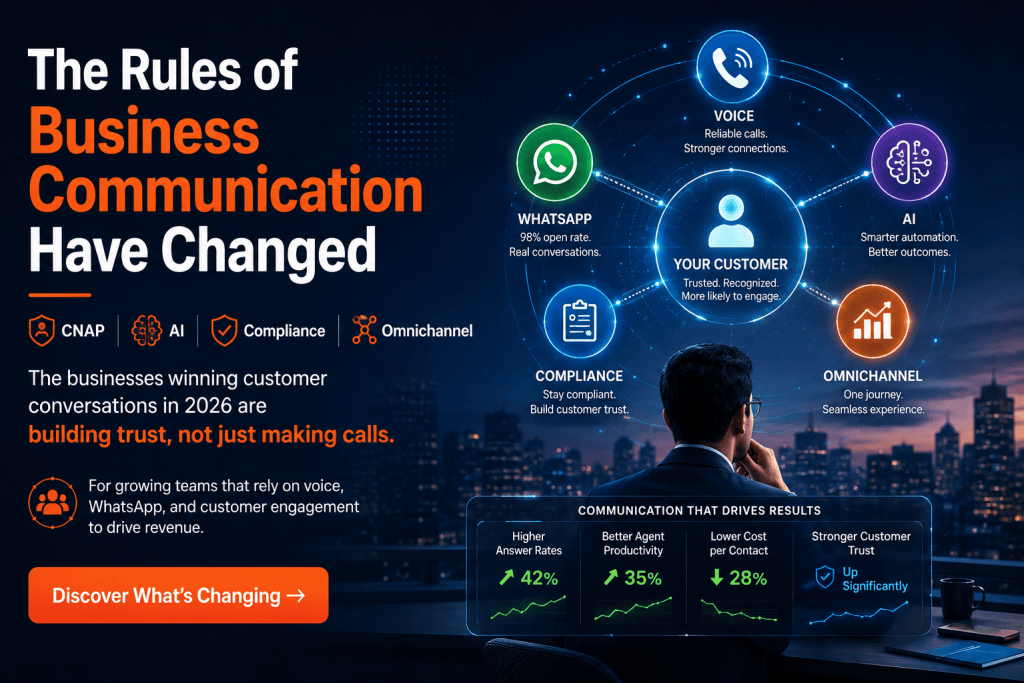
For years, businesses chose cloud telephony platforms based on features. IVR. Call recording. Dialers. CRM integrations.
In 2026, that’s no longer enough.Three major shifts are changing how businesses evaluate communication platforms:
- Verified caller identity through CNAP
- AI-powered customer engagement
- Stricter compliance requirements
The result? Businesses are moving from buying cloud telephony tools to investing in trusted communication infrastructure.
Trust Is Becoming a Competitive Advantage
With CNAP rolling out across India, customers can increasingly see telecom-verified business identities before answering calls. This means answer rates will depend on more than just dialer performance. Businesses with verified identities and compliant calling infrastructure will have a clear advantage over those relying on fragmented setups.
The question is no longer: “Can I make calls?”
It’s: “Will customers trust my calls enough to answer?”
AI Is No Longer a Future Project
AI has moved from experimentation to operations.
Leading businesses are already using AI to:
- Route calls intelligently
- Automate repetitive interactions
- Summarize conversations
- Improve agent productivity
- Reduce customer wait times
The winners won’t be the companies with the most AI features. They’ll be the ones that use AI to resolve more conversations without adding more agents.
Omnichannel Is Becoming the New Standard
Customers don’t think in channels. A conversation may start on WhatsApp, move to a phone call, and end with a follow-up message.
Businesses that cannot maintain context across channels create friction, longer resolution times, and frustrated customers. Voice, WhatsApp, CRM, and AI can no longer operate in silos.
Reliability Matters More Than Ever
Recent outages across global communication providers revealed an uncomfortable truth:
Cloud communication platforms are only as reliable as the infrastructure behind them.
Carrier routes, network dependencies, and failover capabilities now matter as much as software features. For businesses running customer support, collections, admissions, or sales operations, reliability is no longer an IT metric. It’s a business metric.
What Smart Businesses Are Prioritizing in 2026
Before choosing a communication platform, ask:
- Is it ready for CNAP and regulatory changes?
- Can it unify voice, WhatsApp, and customer context?
- Does it offer AI that improves outcomes, not just features?
- Can it scale without increasing complexity?
- Is the underlying infrastructure built for reliability?
The answers to these questions will matter far more than another dialer feature or dashboard.
The Bottom Line
The future of business communication isn’t just cloud telephony. It’s trusted identity, compliance, AI, omnichannel engagement, and carrier-grade reliability working together.
The businesses that adapt now will improve customer trust, agent productivity, and operational resilience. The ones that don’t may find themselves using modern tools with outdated communication strategies.
The market has moved. The question is whether your communication stack has moved with it.

Leave a Reply